Almost every solar system on a council building needs approval from the local distribution network operator (DNO) under G99, and that's usually the longest step. Rooftop solar on non-domestic buildings in England is generally permitted development, but listed buildings, conservation areas and car park canopies need more care.
The grid connection: G99
Systems above 50 kW three-phase need a full G99 application, a network study and a formal connection offer before they're installed. Smaller commercial systems use a shorter G99 form.1 Larger systems are grouped by size, with Type A covering over 50 kW up to 1 MW and Type B from 1 MW to under 10 MW.1
Allow around 12 weeks for a typical rooftop application to reach an offer, longer where the local network is constrained. Since 2025 the queue for larger connections has been reordered on a "first ready and needed, first connected" basis.3
Export limits. If the network can't take full export, the DNO may offer a connection with an export limit. A building that uses most of its output, such as a leisure centre, loses very little to a limit. Your half-hourly data shows how much you'd export at each size.
Planning permission
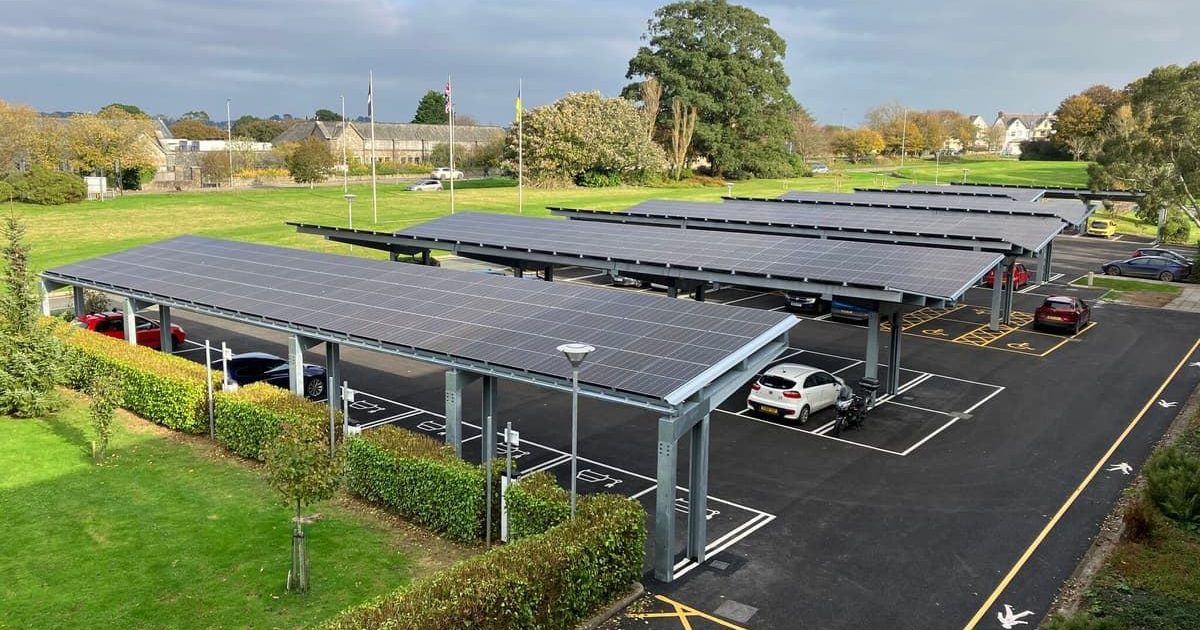
In England, since December 2023, rooftop solar on non-domestic buildings has been permitted development with no capacity limit. Solar canopies over non-domestic car parks have their own permitted development right, within limits on height and distance from homes, but need prior approval before work starts.2
- Listed buildings still need listed building consent. Many town halls, libraries and older schools are listed.
- Conservation areas and Article 4 directions can remove or limit permitted development.
- Ground-mounted arrays on council land usually need full planning permission.
- Scotland and Wales have their own rules.
- The council is also the planning authority, so keep the applicant and decision-maker roles properly separated.
Checks specific to council buildings
| Issue | What to do |
|---|---|
| Schools | Plan roof works for the holidays, with safeguarding and site access agreed with the school. |
| Leased and operated buildings | Leisure operators, academies and tenants may need to consent, and agree who gets the savings. |
| Roof condition | Get a structural survey, check remaining roof life, and look for asbestos and fragile rooflights. |
| Fire safety | Involve your fire safety adviser and insurer early, with isolation and cable routing designed in. |
A realistic timeline
A straightforward rooftop project typically takes five to seven months from first estimate to switch-on: feasibility, survey and design, the DNO application running alongside, then contract, installation and commissioning. A programme across many buildings can run DNO applications in parallel.
Sources
Questions people ask
Do councils need planning permission for solar on their buildings?
In England, usually not for rooftops, because rooftop solar on non-domestic buildings is permitted development. Listed buildings, sites with an Article 4 direction and some protected areas are exceptions.
How long does a DNO connection take?
Allow around 12 weeks for a typical rooftop application to reach an offer, longer where the network is constrained.