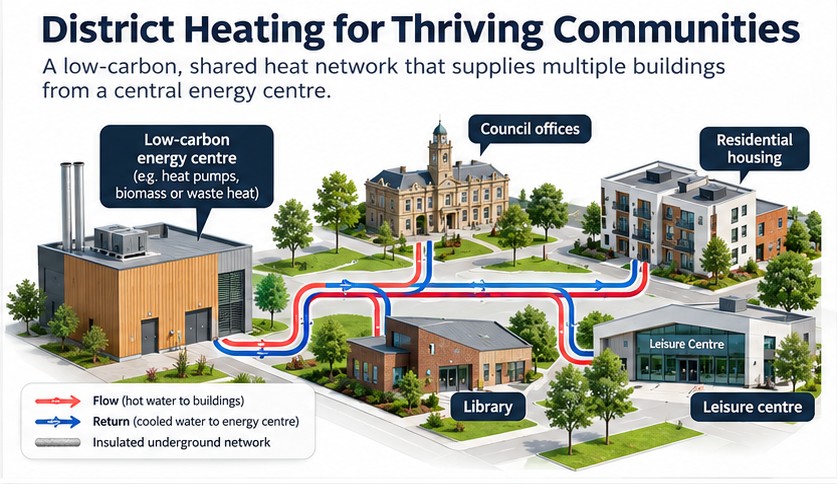
Heat network zoning will designate areas of England where heat networks are expected to be the lowest-cost low carbon heat. Certain buildings in a zone may be required to connect within set timescales, and council buildings are often the anchor loads that make a network viable. Councils also take on a structured role in coordinating zones.
What zoning is
The Energy Act 2023 gives government the powers to bring in heat network zoning in England through regulations. The approach was tested with pilot projects in 28 English towns and cities, some of which are now being progressed as the first zones.1 Government published its response to the zoning consultation in January 2026, and says it will support at least 10 of the biggest English towns and cities to establish zones soon after the regulations go live. A heat network zoning authority will sit in the Department for Energy Security and Net Zero at first, then move to the Warm Homes Agency.2
Heat networks currently supply around 3% of heat in the UK.3
Will your buildings have to connect?
Certain types of buildings in zones may be required to connect within defined timescales.4 Large public buildings with steady heat demand, such as civic offices, leisure centres and schools, are typical anchor loads. If your buildings are in a likely zone, plan boiler replacements with a connection in mind, rather than putting in new gas plant that will be stranded.
The council role
Under zoning, local authorities take on structured delivery and oversight of zones, supported by national funding and standards. Councils that both coordinate a zone and want to bid to develop it need to separate those roles in their governance. Finance is available: the National Wealth Fund has lent to council heat networks such as Hull's city centre scheme.5
How to prepare
- Map your buildings against the zoning pilot outputs and any emerging zones.1
- Know each building's heat demand profile and plant age, so you can say which are ready to connect and when.
- Check electrical headroom too: some buildings will be better on their own heat pumps than on a network.
- Talk early with anyone developing networks near your estate.
Sources
Checked 28 November 2026.
- GOV.UK: Heat network zoning (collection)
- GOV.UK: Heat network zoning consultation 2023, summary of government response (January 2026)
- Department for Energy Security and Net Zero: Heat network zoning, overview of proposals (January 2026)
- GOV.UK: Heat networks and zoning flyer (January 2026)
- National Wealth Fund: backs Hull city centre heat network
Questions people ask
What is heat network zoning?
A new approach in England, using powers in the Energy Act 2023, to designate areas where heat networks are expected to be the lowest-cost low carbon heat. Certain buildings in a zone may be required to connect within set timescales.
When does heat network zoning start?
Government's January 2026 response said implementation regulations would come in 2026, with at least 10 of the biggest English towns and cities supported to establish zones soon after.
Will council buildings have to connect to a heat network?
Some may. Certain building types in a zone may be required to connect within defined timescales. Large public buildings with steady heat demand are typical anchor loads.