A council estate is usually hundreds of buildings on dozens of contracts: schools, leisure centres, offices, libraries, depots, community halls and street lighting. Treated one building at a time, decarbonisation stalls on capacity and funding. Treated as one programme, the estate can be ranked from measured data, bundled into packages big enough to attract finance, and delivered at pace. The order that works: measure, cut waste, check electrical headroom, add generation where it pays, then replace fossil heat as plant reaches the end of its life.

Why it matters even if net zero isn't the headline
Energy is one of the biggest controllable costs a council has. In leisure, energy is typically an operator's second biggest cost after staff, and leisure centres can make up as much as 40% of some councils' direct emissions.9 Some councils have withdrawn their climate targets since May 2025.8 The case on this site doesn't depend on a target. Cutting waste, generating power on your own roofs and replacing failing boilers with cheaper-to-run heat saves money whatever the council's position on net zero.
Five pressures at once
1. Too many buildings, too few people
Most council energy teams are small. A programme of hundreds of feasibility studies, procurements and contracts is beyond them if every building is its own project. That's the single biggest reason estates stall.
2. Funding has changed shape
The Public Sector Decarbonisation Scheme (PSDS) funded a large share of council heat projects in England from 2020, but no further money is being committed beyond projects already awarded. Phase 4 projects run to March 2028.1 Newer money is more targeted, such as Great British Energy's Local Power Plan, backed by up to £1 billion for local and community energy.2 Projects increasingly need to pay for themselves, using borrowing, energy performance contracts, power purchase agreements or long-term partnerships. See funding routes.
3. The grid connection
Heat pumps replace gas with electricity, so a building's peak demand rises, usually in the coldest weeks. Leisure centres and civic offices often run closer to their agreed supply capacity than anyone realises, and upgrades can take years. See supply capacity and headroom.
4. Heat networks are coming
Heat network zoning will identify areas of England where heat networks are the lowest-cost low carbon heat, and certain buildings in a zone may have to connect. Government says it will support at least 10 of the biggest English towns and cities to set up zones soon after the regulations go live.6 Council buildings are often the anchor loads. See heat networks and zoning.
5. Falling grid carbon changes old answers
The UK government's electricity carbon factor for 2026 reporting is about 0.13 kg CO₂e per kWh, down from 0.177 for 2025.7 Every year electric heat looks better and gas looks worse, which changes the case for older gas CHP in leisure centres and offices.
A practical order to work in
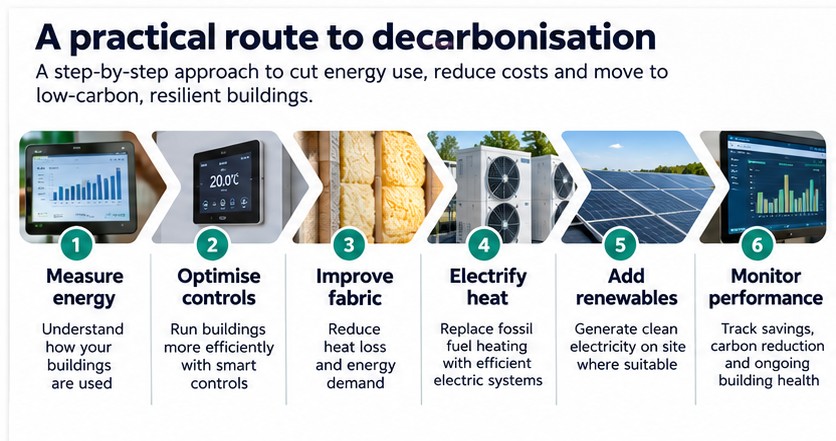
- Get the data. Most councils already have half-hourly readings for their larger buildings, through their supplier or energy bureau. See getting your data.
- Rank the estate. Load every meter into the analyser and compare buildings of the same type side by side: base load, out-of-hours use, peaks against capacity and solar fit.
- Cut the waste first. Controls, timeclocks and setback fixes cost little and shrink everything you'll buy later, including heat pumps.
- Check headroom. Know which buildings can take a heat pump or EV chargers on their current connection, and which need an upgrade.
- Add generation where it pays. Solar on buildings that use their own output, such as leisure centres and depots, often pays back first.
- Replace fossil heat at end of life. Plan heat pumps or a heat network connection before boilers fail, so you aren't forced into a like-for-like gas replacement.
- Package it. Bundle buildings into programmes big enough to finance and procure once. See delivery models compared and long-term energy partnerships.
Why one programme beats 200 projects
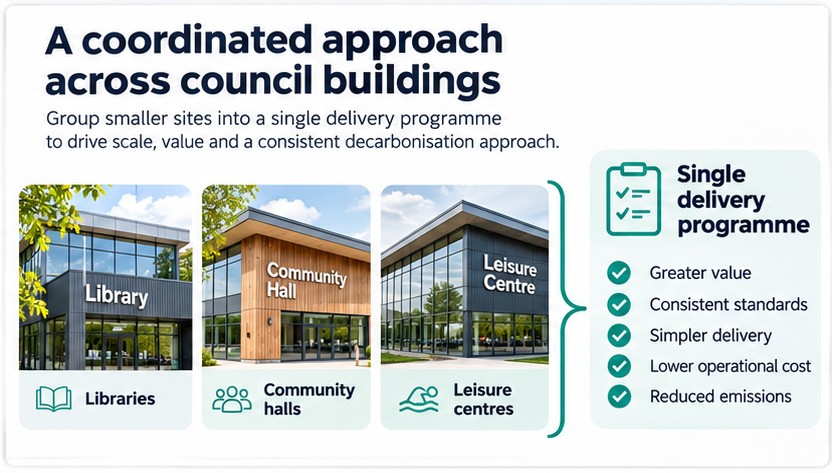
A single building rarely justifies the cost of a feasibility study, a procurement and a contract. A programme does. Bundling lets strong paybacks (lighting, controls, solar) carry harder measures (heat pumps, fabric). It gives a lender or partner a pipeline worth pricing. And it means your team procures once and manages one relationship, not dozens. Frameworks like RE:FIT, energy performance contracts and long-term partnerships all exist to make that possible.5 The National Wealth Fund also lends to local authorities for strategically important projects.4
Sources
Checked 28 November 2026.
- Salix Finance: Public Sector Decarbonisation Scheme update
- GOV.UK: Local Power Plan (February 2026)
- Great British Energy: first anniversary announcement (15 May 2026)
- National Wealth Fund: Regional Project Accelerator for local government
- Mayor of London: RE:FIT, the national carbon and energy performance contracting framework
- GOV.UK: Heat network zoning consultation 2023, summary of government response (January 2026)
- Department for Energy Security and Net Zero: Greenhouse gas reporting, conversion factors 2026
- Grantham Research Institute, LSE: The Reform UK party's approach to climate change and net zero in local councils (March 2026)
- Local Government Association and ukactive: briefing for councils on rising energy costs in the leisure sector
Questions people ask
Where should a council start with decarbonising its estate?
With the half-hourly data it already has. Ranking every metered building by base load, out-of-hours use, peak against capacity and solar fit shows where the quick savings are and which buildings are ready for heat pumps, before any money is spent on surveys.
Is PSDS still open to councils?
In England, no new funding is being committed beyond projects already awarded. Phase 4 projects remain funded until 31 March 2028. Other routes now matter more: borrowing, the National Wealth Fund, Great British Energy, energy performance contracts and partnerships.
Does this only matter for councils with a net zero target?
No. Cutting waste, generating your own electricity and replacing failing boilers with cheaper-to-run heat saves money whatever a council's climate policy.