Most UK councils declared a climate emergency from 2019, and many set a net zero target for their own operations, often 2030, with a later target for the wider area. Buildings, street lighting and fleet usually make up most of a council's own emissions, so a credible plan starts with knowing what each building uses and when.
Declarations and targets
By late 2019, 261 of the UK's 408 principal local authorities had declared a climate emergency, many with net zero targets for their own operations as early as 2030.1 Climate Emergency UK reported that 327 councils had published a climate action plan.2 The UK Climate Change Committee has said up to a third of local emissions are within the scope and influence of local authorities.2
Targets aren't universal or fixed. Some councils have withdrawn their climate targets since May 2025.3 Whatever your council's position, the energy bill is real, and most of what cuts carbon on an estate also cuts cost.
What an own-estate target usually covers
- Buildings: gas and oil for heating, and electricity, across offices, schools, leisure, libraries and depots.
- Street lighting: often one of the biggest single electricity loads a council has.
- Fleet: refuse vehicles, vans and pool cars.
- Sometimes: outsourced services such as leisure operators, and maintained schools.
Electricity carbon is falling fast
The UK government's electricity conversion factor for 2026 reporting is about 0.13 kg CO₂e per kWh, down from 0.177 for 2025.4 So switching heat from gas to electricity cuts more carbon each year, and estates that cut gas will see their reported emissions fall faster than those that only cut electricity.
From target to plan
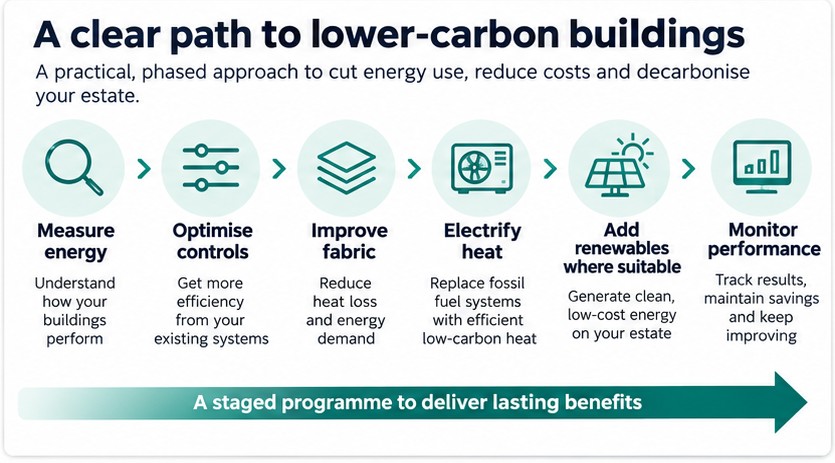
A target becomes a plan when every building has a measured baseline, a list of measures, a cost and a date. Half-hourly data gives the baseline, shows the waste and tells you which buildings can take heat pumps on their current connection. Load the estate into the analyser to start.
Sources
Checked 28 November 2026.
- Carbon Trust: Local authority climate emergency, what's next?
- UK100: What makes a strong climate action plan (Climate Emergency UK)
- Grantham Research Institute, LSE: The Reform UK party's approach to climate change and net zero in local councils (March 2026)
- Department for Energy Security and Net Zero: Greenhouse gas reporting, conversion factors 2026
Questions people ask
How many councils have declared a climate emergency?
Most. By late 2019, 261 of the UK's 408 principal local authorities had declared one, and Climate Emergency UK has since reported 327 councils with a published climate action plan. Some councils have since withdrawn targets.
What does a council own-estate net zero target cover?
Usually buildings, street lighting and fleet, and sometimes outsourced services such as leisure operators and maintained schools.