Solar payback is the number of years until the savings equal the installed cost. On council buildings it's driven mainly by how much of the output the building uses itself. Leisure centres and depots usually pay back fastest; schools and libraries that close at weekends and in holidays take longer unless the system is sized carefully. Run each building through the solar calculator with the share used on site measured from its half-hourly data.
What payback does and doesn't tell you
The calculator reports simple payback: the year when cumulative savings pass the installed cost, without discounting.1 It's a fair first filter for a capital bid, but it ignores the years of savings after break-even, which is where most of a solar system's value sits. Look at the 25-year net benefit the calculator also shows.1
Under a power purchase agreement (PPA) there's no payback, because you spend no capital. You compare the PPA rate with what you'd otherwise pay. See paying for solar.
What decides payback on council buildings
| Factor | What to know |
|---|---|
| Share used on site | The biggest factor. Our made-up leisure centre would use every unit from a system of up to about 180 kWp. Schools export much more in summer. |
| Unit price | Councils buying through public sector energy frameworks may pay different rates from small businesses. Use your real all-in unit rate. |
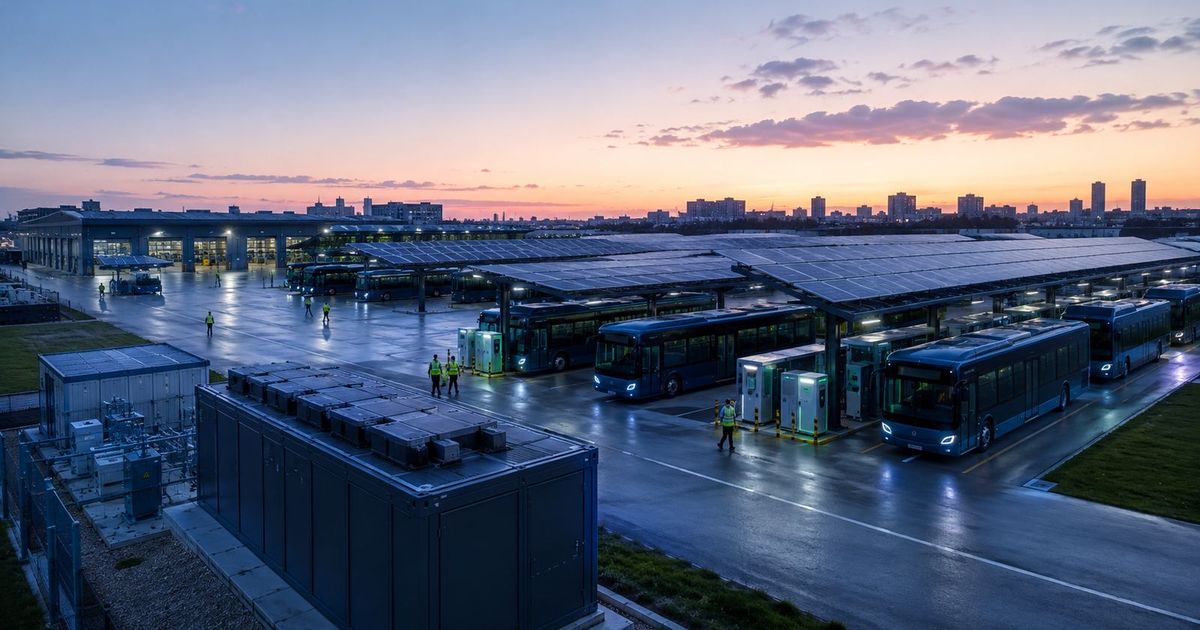
| Mounting | Flat roofs with plant fit fewer panels. Car park canopies at depots and leisure centres add space but cost more per kWp. |
| Roof condition | If a roof needs replacing within ten years, do it first. Lifting and refitting panels later costs money and time. |
| Location | Southern England generates more per kWp than Scotland, so the same system pays back sooner in the south.1 |
What the calculator's payback includes
The figure covers the installed cost, savings on electricity used on site, export income at 5p/kWh, electricity prices rising 3% a year, panel output falling 1% in year one and 0.4% a year after, one inverter replacement in year 13, and running costs for maintenance, monitoring and insurance rising with inflation.1 It doesn't include roof repairs, structural work, network reinforcement charges, finance costs or staff time.
Business rates
Councils pay business rates on many of their own buildings. In England, plant used for on-site renewable generation, and batteries used with it, has been exempt from April 2022, so solar shouldn't add to the rates bill.2
How to shorten payback
- Measure the share used on site from half-hourly data instead of assuming it.
- Size to what each building uses. A system the building uses entirely usually pays back faster than a bigger one that exports at weekends.
- Start with the best buildings. Rank the estate and do leisure centres and depots first.
- Bundle. A programme across many roofs shares design, procurement and access costs.
- Check funding first. A grant or a PPA changes the capital cost. See funding routes.
Sources
Questions people ask
Which council buildings have the fastest solar payback?
Usually leisure centres with pools and depots, because they use most of the output during the day. Schools and libraries take longer unless systems are sized to their term-time and opening-hours demand.
Will solar increase our business rates?
Not in England. On-site renewable generation, and batteries used with it, are exempt from business rates from April 2022 under SI 2022/405.