For each half-hourly electricity meter, ask your supplier, or whoever manages your energy contract, for 12 months of half-hourly consumption in kWh, one file per meter, as Excel or CSV. If your energy team runs a monitoring and targeting system, it probably already holds the same data and is quicker to export. For buildings run by someone else, such as a leisure operator or an academy trust, ask them.
Who holds it in a council
| Who | What they usually have |
|---|---|
| The electricity supplier | Settlement data for every half-hourly meter, often downloadable from a business portal |
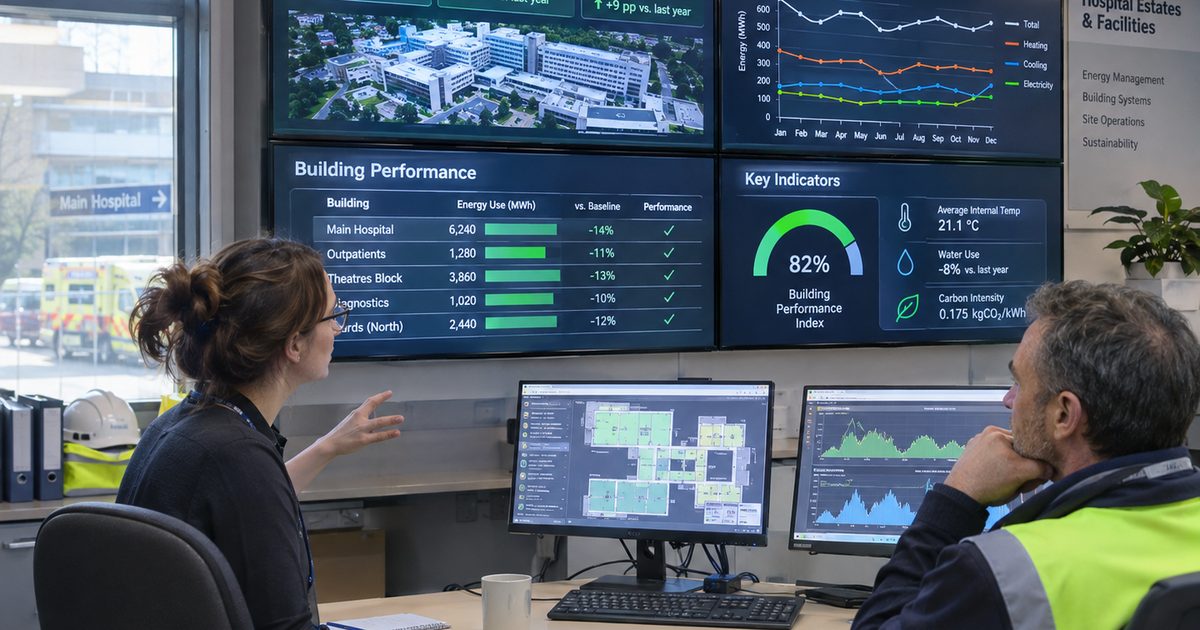
| The council's energy team or energy bureau | A monitoring and targeting system with every meter in it, often already importing half-hourly data each day |
| The public buying organisation that runs the energy contract | Access to supplier portals and bureau services for the councils it buys for |
| Leisure operators and trusts | On outsourced leisure centres, often the supply contract and the meter data |
| Schools and academy trusts | Maintained schools are often on the council's contract; academies usually buy their own energy |
| PFI or facilities management providers | On PFI schools, offices and leisure buildings, often the supply and the data |
Most councils buy electricity through a public sector framework, so the relationship with the supplier may sit with a corporate energy or procurement team rather than property or estates. Start with whoever pays the bill.
Which meters to ask for
- Every half-hourly import meter on the estate, including second incomers on larger buildings.
- Generation meters for any solar or CHP, so you can see true building demand, not just import.
- Sub-meters for pool plant, sports halls, data rooms or tenanted floors, if you have them. They make findings much more specific.
- Schools, offices and libraries with half-hourly meters, which is where out-of-hours savings usually sit.
The MPAN, the 13-digit supply number on the bill, identifies each meter. How to read an MPAN.
What to ask for
Please send half-hourly consumption data (kWh) for the MPANs listed below, from [date] to [date], as one Excel or CSV file per meter, with one row per day and 48 half-hourly columns. Please name each file after the site.
- One file per meter, named after the site. The analyser uses the file name as the site name.
- Twelve months minimum; up to three years shows trends and a before-and-after for past projects.
- kWh per half hour is best. kW works too, and the analyser says which it found.
Download a request letter template (Word), with spaces for your MPANs and dates.
Your right to the data
Since 1 December 2022, business customers with a smart or advanced (AMR) meter, and anyone they nominate, can ask their supplier for up to 12 months of historic smart meter data free of charge, in a machine-readable format. The supplier must reply within 10 working days.1 For supplier-specific routes, see our guides to British Gas, EDF, E.ON Next, npower Business Solutions and TotalEnergies.
Formats the analyser reads
Excel (.xlsx, .xls) or CSV, laid out as one day per row with 48 readings, one day per column, or one timestamped reading per row. Extra columns such as meter references are ignored. If a file can't be read, the analyser says why. To see what a good file looks like, download our example leisure centre file.
Information governance
Half-hourly electricity data records energy use, not people, so it contains no personal information. The analyser reads files on your own computer and uploads nothing. If your information governance team wants the detail, share the privacy notice.
If a site has no half-hourly meter
Ask the supplier whether the meter can be replaced with a smart or advanced meter that records half-hourly. Check whether the BMS or a monitoring system logs the main meter's pulse output. Monthly readings show the seasons, but not the nights, weekends and peaks this analysis depends on.
Questions people ask
Who holds half-hourly data for council buildings?
The electricity supplier, always. Often also the council's energy team or energy bureau through an automatic monitoring and targeting system, the public buying organisation that runs the energy contract, and for outsourced buildings the leisure operator, the school or the PFI facilities management provider.
How much data should we ask for?
At least 12 months for every half-hourly meter, and up to three years if it exists. A full year captures term time and holidays, winter heating and summer peaks.
Is there a charge?
Business customers with a smart or advanced meter can ask for up to 12 months of historic data free of charge. Many suppliers and bureaux also offer downloads in their online portals.
Does the data contain personal information?
No. It is the electricity used by the building in each half hour, nothing more. The analyser also keeps it on your computer.